Showing posts with label Silk. Show all posts
Showing posts with label Silk. Show all posts
12 September 2012
Weighting of Silk
Weighting of Silk:
The process of increasing the weight of the silk material is known as weighting of silk.
Object of Silk Weighting:
Object of Silk Weighting:
- After the processing of silk material, it loses about 25% of its weight particularly after degumming.
- This loss in weight leads to a great loss of money since they are very expensive.
- To compensate the loss, some weight is artificially added to the material by chemical means.
- During degumming of silk, a weight loss of 25% is normally observed in case of silk fabrics.
- Owing to the expensive nature of silk, it is necessary to compensate the weight loss.
 |
| Silk Weighting |
Other Objects:
Tin salts are widely used for silk weighting.
There are three methods which are followed:
1st method:
The silk is soaked with stannic chloride solution followed by fixation with sodium carbonate followed by soaping.
Marginal weight increase is observed but the strength is also adversely affected in this method.
2nd method:
3rd method:
Stannic chloride + sodium phosphate Tin phosphate
Tin phosphate + sodium silicate Tri silicate of tin
http://textilelearner.blogspot.com/2013/01/weighting-of-silk-object-of-silk.html
- Weighting is also done to reduce limpness.
- To impart a bulky effect.
- To control the scroopy effect.
- To give body to the fabric.
- To give a greater filling capacity.
Tin salts are widely used for silk weighting.
There are three methods which are followed:
1st method:
The silk is soaked with stannic chloride solution followed by fixation with sodium carbonate followed by soaping.
Marginal weight increase is observed but the strength is also adversely affected in this method.
2nd method:
- The silk is soaked in stannic chloride and the fixed with sodium phosphate.
- It is then washed and treated with little amount of sulphuric acid.
- It is then soured, washed and taken out.
3rd method:
- In this method the fixation is done with sodium silicate.
- This brings out the required increase in weight without affecting the strength much.
- In the normal practice silk is soaked in stannic chloride solution called Picking.
- Later it is treated with sodium phosphate called Phosphating.
- The picking and Phosphating is carried out alternatively till the sufficient weight is achieved and the sequence is:
- Picking washing - Phosphating - acidifying
- Finally after sufficient loading it is treated with Sodium Silicate.
Stannic chloride + sodium phosphate Tin phosphate
Tin phosphate + sodium silicate Tri silicate of tin
http://textilelearner.blogspot.com/2013/01/weighting-of-silk-object-of-silk.html
13 July 2012
Scouring Process of Silk
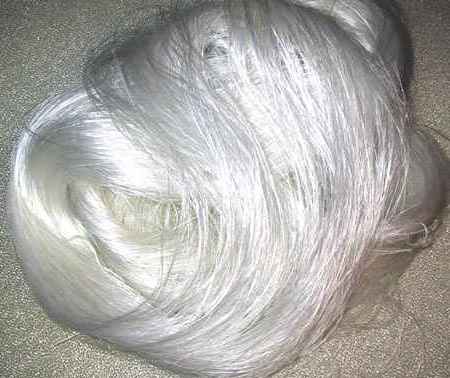
Degumming
A major undesirable constituent part of silk
is ‘silk gum’ or ‘sericin’ about 25% of total mass. Sericin is removed
by degumming. Degumming is the process of removing the sericin, or silk
gum, from silk. Removing the gum improves the sheen, color, hand, and
texture of the silk. Because the gum can serve as a protective layer, it
is typically left on the silk until it is ready to dye. In some cases,
the fabric is woven to completion, and then degummed, to protect the
yarn from abrasion on the loom. The process involved to remove these
impurities is called ‘degumming’ or ‘scouring’ of silk.
 |
| Silk |
Fibroin - 70-80%
Sericin - 20-305
Waxy matter - 0.4-0.8%
Carbohydrates - 1.2-1.65
Inorganic matter - 0.7%
Pigment - 0.2%
The process of eliminating “Gum (sericin)” from raw silk is known as degumming of silk. Degumming of silk involves mainly the removal of sericin from the fibroin. Sericin is insoluble in water. It is comparatively easily hydrolyzed, whereby the long protein molecule of sericin, is broken down into smaller fractions, which are easily dispersed or solubillsed in hot water.
Typical Recipe for Silk Degumming:
Wetting agent……………………=0.5-1.0 g/l
Sequestering agent…………….=1.0-2.0 g/l
Antifoaming agent……………...=0.5-1.0 g/l
Natural soap…………………….=15.0-30.0 g/l
TSP/Soda ash…………………..=1.0-3.0 g/l
Detergent………………………..=1.0-3.0 g/l (not mandatory if use soda)
Temperature…………………….=90-95°C
Time………………………………=90-120 min
pH…………………………………=9.5-10.5
M:L………………………………..=1:10
Working Procedure:
- Set the bath with substrate at room temperature and add soap and other necessary auxiliaries.
- If necessary add trisodium phosphate (TSP) or soda ash to maintain desired pH 9-10.
- Raise the temperature to 95° and run for 2 hours for optimum removal of sericin gum.
- Cool down to 70°C and then drop the bath.
- Wash it with warm and cold water successively.
2 May 2012
Chemical Composition of Natural Fiber
Chemical Composition of Natural Fiber:
Every fiber consists of some chemical elements. Such as cotton contains cellulose, protein, pectin etc. Wool contains keratin, dirt, suint etc. Chemical composition of natural fibers are given below:
Chemical Composition of Cotton Fiber:
Chemical Composition of Jute Fiber:
Chemical Composition of Linen/Flax Fiber:
Chemical Composition of Hemp Fiber:
Chemical Composition of Sisal Fiber:
Chemical Composition of Coir Fiber:
Chemical Composition of Wool Fiber:
Chemical Composition of Keratin:
Every fiber consists of some chemical elements. Such as cotton contains cellulose, protein, pectin etc. Wool contains keratin, dirt, suint etc. Chemical composition of natural fibers are given below:
Chemical Composition of Cotton Fiber:

- Cellulose 94%
- Protein 1.3%
- Ash 1.2%
- Pectin 1.2%
- Oil, Fat and Wax 0.6%
- Sugar 0.3%
- Pigment trace
- Others 1.4%
Chemical Composition of Jute Fiber:
- Cellulose 65.2%
- Hemicellulose 22.2%
- Lignin 10.8%
- Water soluble 1.5%
- Fats and wax 0.3%
Chemical Composition of Linen/Flax Fiber:
- Cellulose 92%
- Hemicellulose 2%
- Lignin 4%
- Others 2%
Chemical Composition of Hemp Fiber:
- Cellulose 77.77%
- Hemicellulose 10%
- Lignin 6.8%
- Pectin 2.9%
- Fat & wax 0.90%
- Water soluble 1.73%
Chemical Composition of Sisal Fiber:
- Cellulose 71.5%
- Hemicellulose 18%
- Lignin 6%
- Pectin 2.3%
- Fat & wax 0.5%
- Water soluble 1.7%
Chemical Composition of Coir Fiber:
- Husk 14%
- Fiber 22%
- Pith 16%
- Kernel 30%
- Water 18%
Chemical Composition of Wool Fiber:
- Keratin 33%
- Dirt 26%
- Suint 28%
- Fat 12%
- Mineral matter 1%
Chemical Composition of Keratin:
- Carbon 50%
- Hydrogen 12%
- Oxygen 10%
- Nitrogen 25%
- Sulfher 3%
Chemical Composition of Silk Fiber:
- Fibroin 76%
- Sericin 22%
- Fat & wax 1.5%
- Mineral salt 0.5
Subscribe to:
Posts
(Atom)